Understanding Organic Farm Exits
Understanding Organic Farm Exits: Insights from Data and Research
An analysis of trends in organic certification retention and what the data tells us about supporting farmer success
By Mallory Krieger
OATS National Program Director and consultant at Terra Elossa LLC
Published April 20th, 2026
The following analysis was presented at a webinar hosted by the National Organic Coalition on January 16, 2026.
The organic sector has seen remarkable growth over the past two decades, but while new operations continue entering organic certification at encouraging rates, a significant number are also leaving.
Mallory Krieger, National Program Director for the Organic Agronomy Training Service (OATS), and organic consultant at Terra Elossa LLC, undertook an analysis of the USDA Organic Integrity Database (OID). This database is maintained by the National Organic Program (NOP) and functions as an administrative snapshot, showing certification status of all operations in the organic program at the present time. A preliminary analysis of this data reveals insights into the characteristics of who is entering and leaving certification.
Diving into the Data
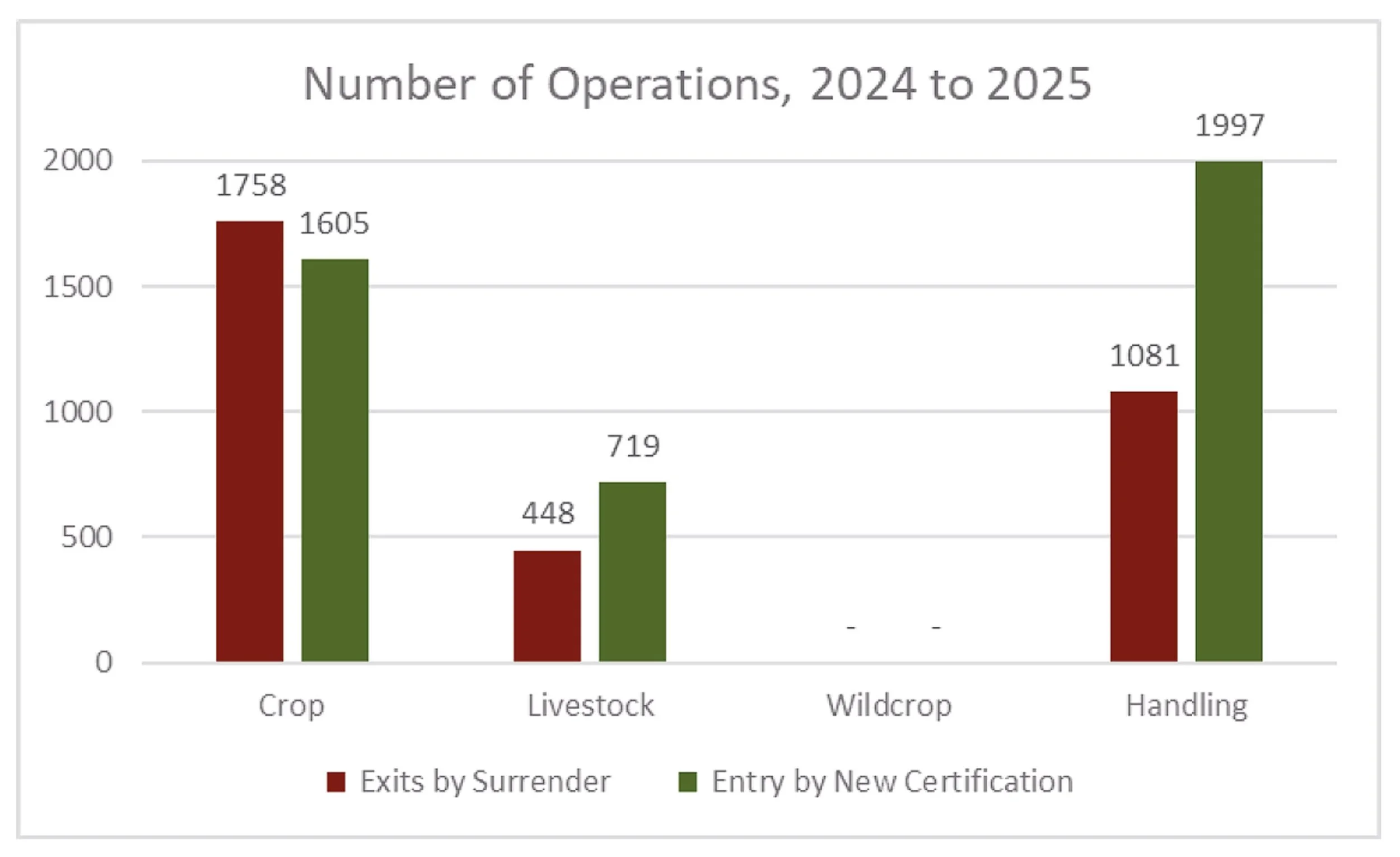
As of December 20, 2025, 28,881 operations are certified organic in the United States. Over the duration of 2025, 3,539 operations newly entered certification, while 2,825 operations voluntarily surrendered their certificates. Accounting for all changes (including suspensions and reinstatements), the organic sector saw a net gain of 792 operations overall across all certification scopes (crops, livestock, and handling).
While a net gain appears favorable, the overall number masks important variations by sector and geography. The crop sector experienced a net loss of 153 operations, 1,758 exits by voluntary surrender with only 1,605 new certifications. In contrast, livestock operations saw a net gain of 271, and handling operations increased by 916. The handling growth reflects, at least in part, the Strengthening Organic Enforcement rule (SOE), which required many previously uncertified handlers to become certified.
Where Farms Are Leaving
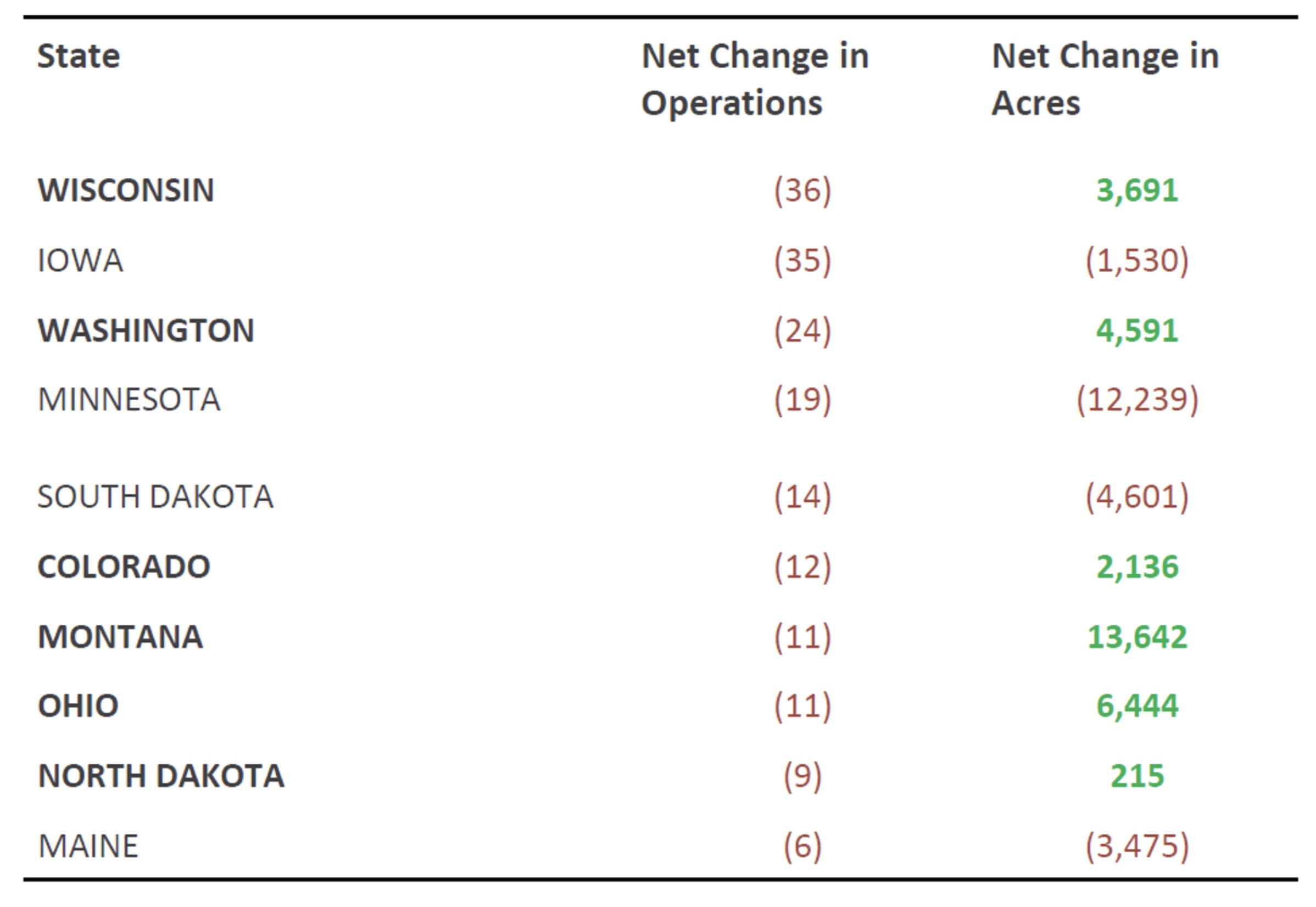
The states with the largest net gains in operations were California with a net gain of 138 operations, followed by New York with 119, Florida with 101, and Missouri with 95. The states that saw the greatest net loss of operations due to voluntary surrender were Wisconsin with 36 farms leaving certification (9% of the state's certified operations), followed by Iowa with 35 operations (10%), and Washington with 24 operations (11%). South Dakota saw the greatest per capita loss with 14 operations leaving certification, 17% of their total certified operations.
Mapping the location of these changes shows a clear pattern: gains cluster tightly around major metropolitan areas such as Los Angeles, New York, Houston, and Seattle, while losses concentrated in rural agricultural regions, such as California's Central Valley, much of the Midwest and Great Plains, rural Wisconsin, and rural Pennsylvania.
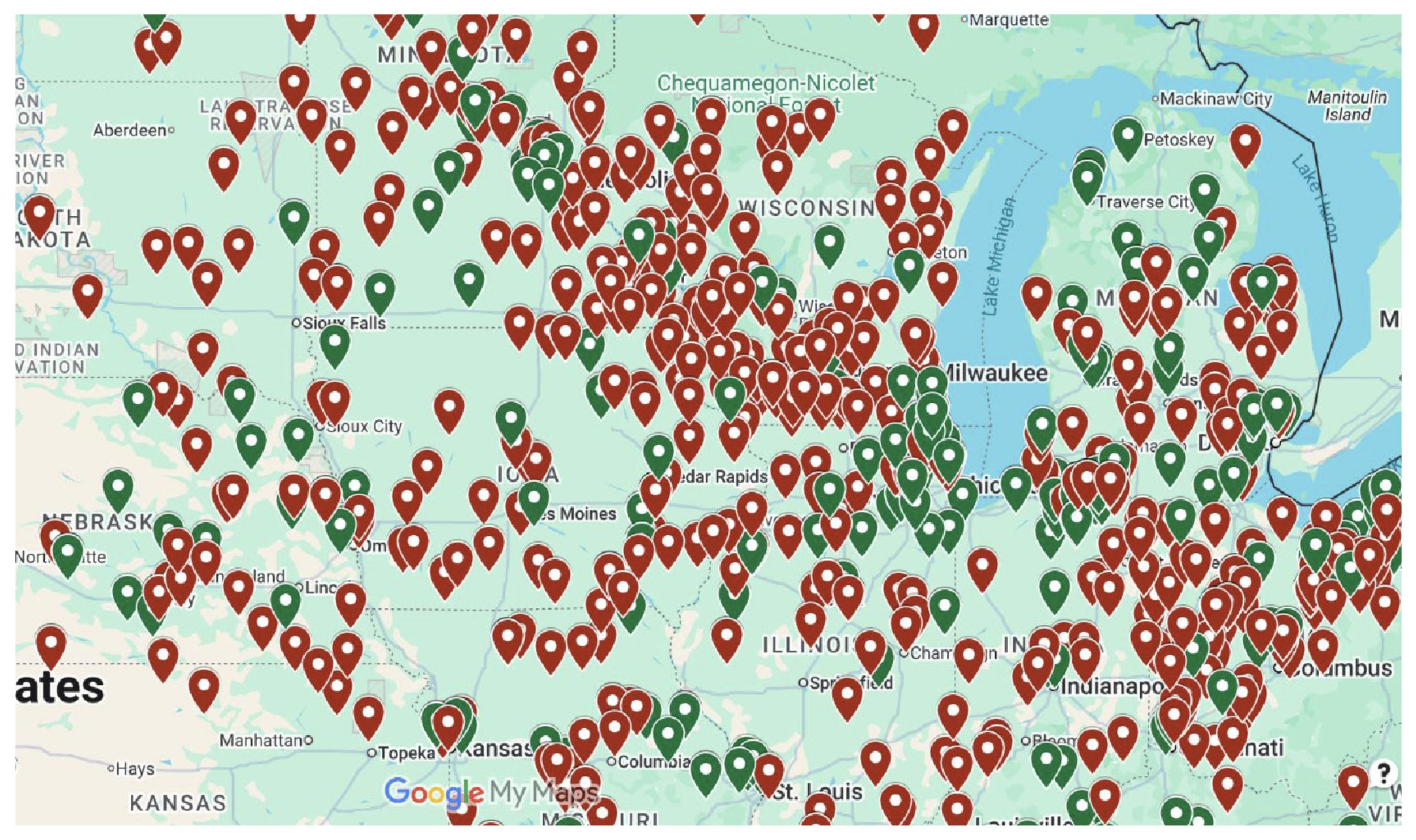
Caption: Midwest region showing clustering of surrenders in rural areas and clustering of new certifications around metropolitan areas; red pins = exits by surrender, green pins = entries by new certification
This urban-rural divide raises questions about market access, consumer demand, and the infrastructure available to support organic farmers in different regions.
The Acreage Story
Changes in certified organic acres show a more concerning trend. 7.7 million acres are currently certified. New certifications in 2025 reported 326,017 acres (4% of total), while newly surrendered operations reported 366,603 acres (5% of total), resulting in a net loss of 40,585 acres. (Acreage data excludes acres certified under the Wild Crop scope.)
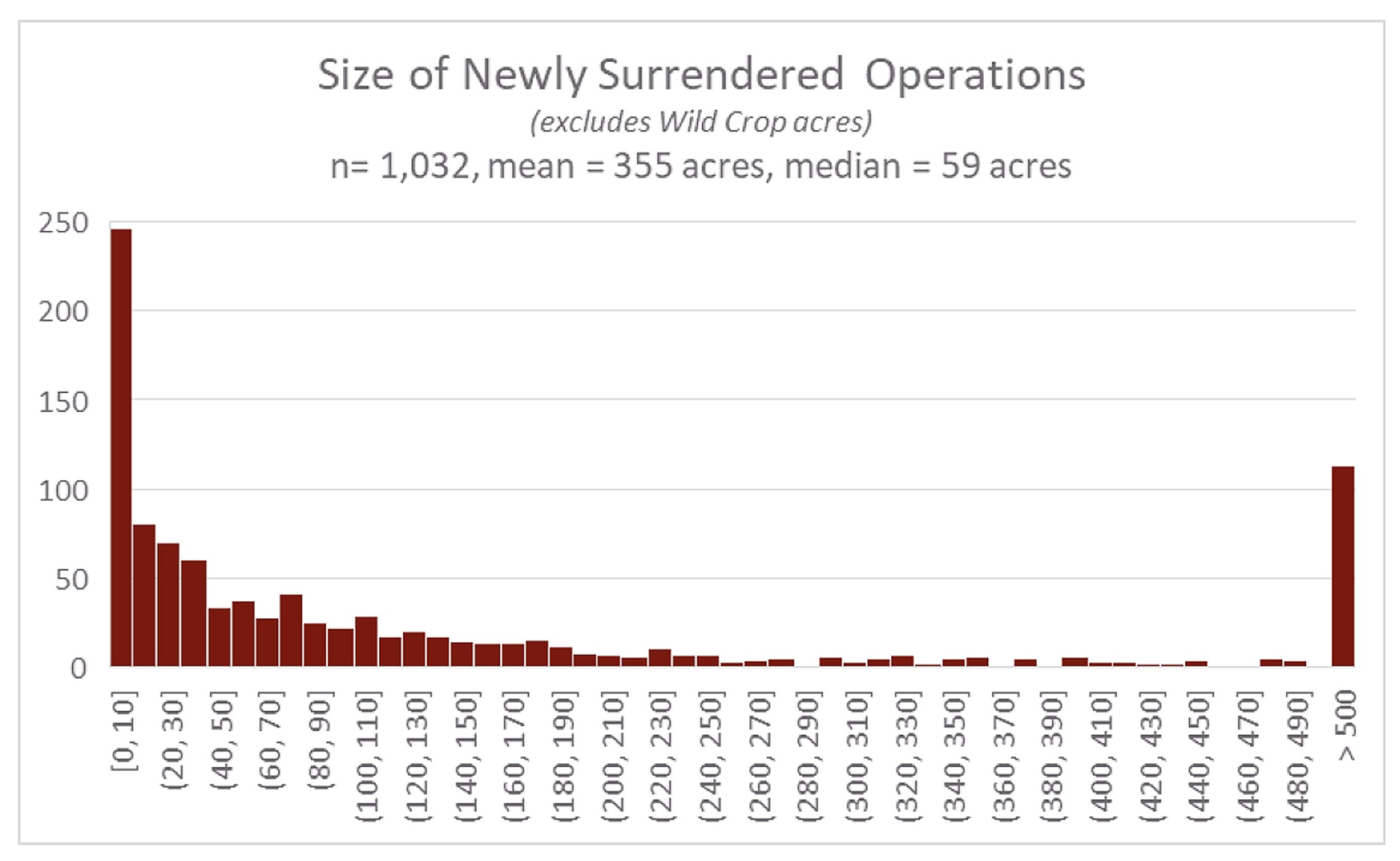
The distribution of farm size reveals something important about organic agriculture's changing structure. Newly certified operations were on average 203 acres with a median of 51 acres, while surrendered operations were on average larger at 355 acres with a median of 59 acres. The organic sector appears to be gaining smaller operations, particularly near urban areas, while losing somewhat larger operations, particularly in rural regions.
State-level acreage data reveals significant losses in certain areas. The state with the largest loss of certified acres was Idaho with a net loss of 91,791 acres—32% of the state's certified organic acreage. Texas lost 15,352 acres (12%), Minnesota lost 12,239 acres (11%), and Oklahoma lost 6,550 acres (24%).
Interestingly, some states with high operation net losses showed acreage gains. Wisconsin lost 36 operations but gained 3,691 acres. Montana lost 11 operations yet gained 13,642 acres. These patterns suggest certified operations may be adding additional acres to their operations, though there are a number of other possible explanations and further analysis of the OID is required to more fully reveal the cause.
Why Farmers Choose Organic—And Why They Leave
Dr. Carolyn Dimitri, a professor at New York University and former USDA researcher, provided crucial context for interpreting these numbers. Her research consistently identifies two categories of motivations for transitioning to organic: values-based reasons including farm sustainability, human health, and environmental stewardship, and economic reasons including increased profit potential and market opportunities.
For farmers who achieve certification but later surrender, market access emerges as the dominant factor. Farmers who cannot find buyers willing to pay fair organic prices find the additional labor, management attention, and certification costs unsustainable.
Access to processing infrastructure poses particular challenges for livestock producers. Many organic farmers with split operations have given up their livestock certification because they cannot find organic processors. Without access to slaughter and processing facilities willing to handle organic animals, these farmers face difficult choices.
Research consistently shows that exits most commonly occur within the first five years of certification, with the third year being particularly critical. “It's three years for transition and then three years of farming organically," Dimitri explained. "And that is the key moment when most farms are going to give up their certification."
Aggregated data from three accredited certifiers shows that approximately 40-50% of farmers who surrender report they are no longer producing organic but are staying in farming. Another 30% go out of business entirely. Only about 8% cite certification costs, and approximately 3% mention paperwork or certification difficulty. Between 20-25% don't provide a reason.
These findings counter a common narrative that record keeping and regulatory burden are a leading reason for operations surrendering certification. The data indicates that market and business opportunity is far more important to retaining operations.
Dimitri's research echoes this: "Most farmers actually said, if we're having a good business, then we're going to keep records and that will make us more profitable." Farmers who are successful economically view record keeping as simply part of doing business.
Looking Forward
The analysis of the 2025 OID data reveals a complex landscape that defies simple narratives. While the organic sector grows overall, rural agricultural regions are losing crop farms while urban areas gain operations. Understanding the patterns and motivations for operations leaving organic certification is essential for developing effective support strategies. Continued investment in organic infrastructure, technical assistance during the critical first five years, and policies that address market access and farm economics will all play important roles in the continued growth of the organic industry.
For advocates and stakeholders, this analysis points to clear action items: improve data collection and research, strengthen market infrastructure, and provide targeted technical assistance to farmers during their most vulnerable years in organic production.
The organic movement has always been about more than just a label. It represents a commitment to farming practices that build soil health, protect biodiversity, safeguard water quality, and produce food without synthetic pesticides and fertilizers. Understanding why farmers leave organic certification—and developing effective strategies to support retention—is essential to realizing that broader vision of a more sustainable and resilient food system.