Biological Seed Treatment and Amendments
Biologicals: A New Frontier in Organic
By Sam Oschwald Tilton
OATS Training Specialist and an Independent Organic Advisor at Glacial Drift Enterprises
Published March 17th, 2026
Organic farmers have always been focused on biology, but in the last decade or two, a biological perspective has become more valued by conventional ag as well. We see this new perspective reflected in the popular term “soil health”. Ag suppliers also have more of a focus on biology, and in recent years, they are formulating more products that work through biology instead of chemistry. Because so many more acres are conventional than organic, changes in conventional often have impacts on organic. This has absolutely been true in the rise of biological inputs.
Biologicals are a wide class of materials that consist of living or once-living organisms that enhance plant growth. Biologicals are currently quite popular in organic and conventional ag. Their quick growth in popularity along with flashy advertising left me wondering how effective these products are for organic grain producers. To cut through the noise, I was happy to have two guests on the Organic Advisor Call Series last season who have great perspectives on biologicals. Dr. Connor Sible is a crop science professor at the University of Illinois who studies biologicals, and Brett Bell is President and CEO of Albert Lea seed, where he evaluates and brings to market biologicals for organic farmers. Both of these ag professionals are dedicated to supporting farmers in ways that enhance profitability, and I learned a lot.
Biologicals are a new product, so the first task, as Dr. Sible cautions, is to define what we’re talking about.
Biostimulant is the more legal term that you might see in the farm bill or other government rules. Biological is the term most of us see in marketing and media. Whatever we call them, what are they? Biologicals are either alive or dead. Dead biologicals are often called biostimulants. They stimulate soil biology, and examples are materials like humic acids and seaweed extracts. They won’t be the focus of this article.
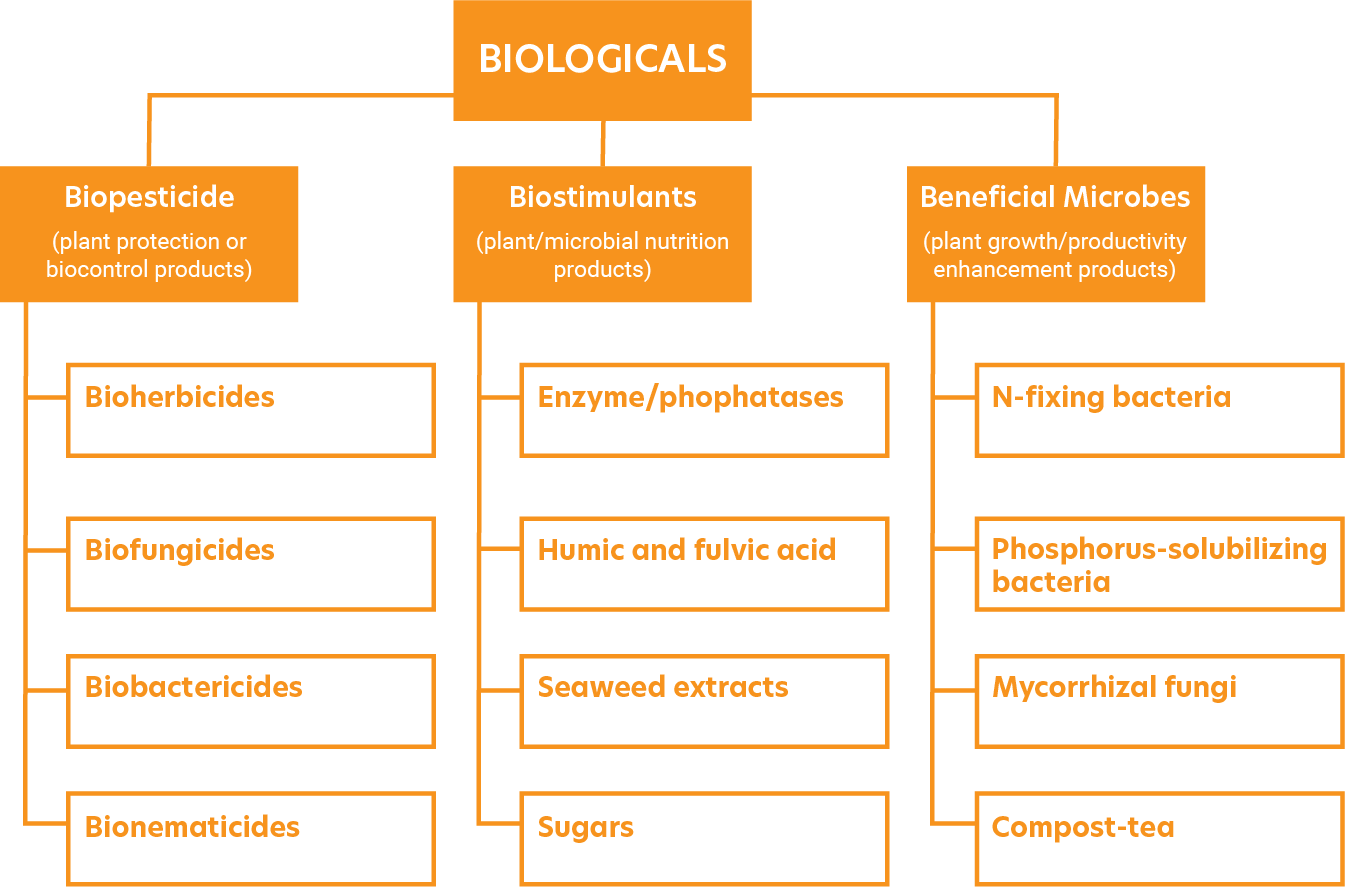
Alive biologicals are forms of microbes (fungi, bacteria, algae) that do things in the soil or to the plant that improve plant growth, and ultimately increase crop yield. They are also called beneficial microbes. They are distinguished from the "nutrition bin" (fertilizers), because they are generally not direct additions of nutrients like nitrogen, phosphorus, or potassium. Instead, they enhance the availability or cycling of nutrients. Biologicals are also distinguished from the "pest management bin" (pesticides), because they are generally not intended to kill pests. Instead, they improve plant health so that plants are less susceptible to disease. For this article I’ll focus on beneficial microbes, but use the term biologicals, since it is the term you’ll most commonly see.
There are two categories that most biologicals on the market fall into:
Those that either add nutrients to the soil (N-fixers) or that make existing nutrients more plant-available (P-solubilizers)
Those that help the soil digest and degrade crop residue more quickly (helpful with cover crops and reduced tillage)
When understanding a particular biological product, reputable companies will give both the microbe's genus (family name) AND species (specific name). For example, Bacillus is a genus of microbe, but Bacillus licheniformis is a species. Biological products tend to take one of two approaches with the microbes they use. One is to formulate the product with a single species of microbe that does one thing well. For example, Albert Lea Seed has a seed treatment consisting only of the fungi Rhizophagus irregularis, because it connects to a root system and makes soil nutrients more plant-available.
The second approach is to formulate biologicals with a consortia of microbes. These products contain several microbial species. A consortium is often used to "cover your bases" environmentally. For example, one species in the consortium might work better in hot/dry conditions while another works in cold/wet conditions. Because biologicals are so new, companies are making many marketing claims, some of which are not backed up by science. Dr. Sible advises that if a consortium contains a large number of microbes, the manufacturer should be able to explain the specific "story" or function of each one. If they can’t it may be a red flag.
There are many ways that the microbes in biologicals can help plants. Some fix atmospheric N to increase the nitrogen in the soil. “Does this mean that if a farmer is using N-fixing biologicals I can recommend that they dial-back their N fertilizer rate?” I asked. “Usually not,” cautioned Dr. Sible. “In general, what our data shows is that we don't want to pull back our nutrients up front. Our crops are smarter than we give them credit for, and when that corn is V3 or V4 it's already reaching out into the soil environment and assessing how much nitrogen and phosphorus it has to work with, and it starts to set its yield ceiling. If we pull back the fertilizer early, the crop might read that and reduce its yield early on. And it's a very long growing season, especially for corn. We need nitrogen availability all season long. Plus, newer hybrids are taking nitrogen up longer into the season than they used to. So if you were to reduce your N-rate because you’re using biologicals, you might have a really, really good year where you could have pulled 200 bu/acre, but because we didn't give enough nitrogen maybe we're only going to pull 170.”
“We tend to see that these biologicals can work well for farmers, but they tend to make good systems even better and more efficient or reliable, rather than trying to replace something.”
– Dr. Connor Sible
We can think of biologicals like fertility insurance. For N we typically have two sources for the crop: N that mineralizes from soil organic matter, and N that we apply in manure/fertilizer. In a given year, depending on conditions, either of those N sources may supply more or less N to the crop. But if we apply an N-fixing biological, we now have a third source that can deliver N to the crop, and diversity is strength. “We tend to see that these biologicals can work well for farmers, but they tend to make good systems even better and more efficient or reliable, rather than trying to replace something.”
Biologicals are becoming quite popular, and their low cost and ease of application are big reasons why.
Economics of Biologicals
Many biologicals are applied in-furrow with the planter or as a seed treatment, and rates are quite low compared to fertilizer, often just a few ounces or gallons per acre. Because the per-acre cost is low (~$10-$20 per acre), they can pay for themselves with even a small yield bump of just a few bushels per acre.
Liquid vs. Dry Biologicals
There tends to be a tradeoff: liquid biologicals are often more effective, but have a shorter shelf life, and are more expensive. Dry formulations generally store better and are most cost-effective, even though they can get dusty at application. Either way, check the label for storage requirements and viable shelf life before you buy.
Biologicals might be inexpensive and effective, but what are guidelines for farmers to use them? An easy way to mess up is to apply or store a biological product the wrong way. A reputable company will explain on the label how the product should be stored, for how long it remains viable, and what it can be mixed with. Does the product need to be refrigerated or kept out of sunlight? If you mix it with manure to ease application will it remain viable? With what application methods is it most effective? Products applied with seed at planting tend to show higher yield gains than those applied foliar or at side-dress. Biologicals do not replace good agronomy - pH, drainage, compaction, or other underlying soil issues are not going to be fixed by a biological silver bullet.
Many farmers want to know if they can apply a biological just once, thinking that it may colonize their soil and make future application unnecessary. Dr. Sible cautions that fungi are not likely to persist in organic systems where tillage is frequent. Introduced bacteria are also unlikely to stick around for multiple seasons because of the sheer volume of native microbe competition. Also, because biologicals appear to work best when consorting with the crop at germination, continuing to apply at planting means they are present where and when they’re needed most.
Unfortunately, because of the greater acres, most biologicals are formulated for conventional systems and not OMRI-approved for organic. Albert Lea Seed worked to develop an organic biological. Their goal was to identify a biological seed treatment that would deliver clear results for organic corn growers. With weed competition identified as the biggest yield limiter, they worked to identify a consortium of biologicals that would result in quicker canopy closure and ultimately a higher yield for the farmer. They wanted materials that would be approved by OMRI as “unrestricted,” meaning it can be applied on any organic acre without approval or additional documentation. They also wanted the product to be a seed treatment so application would be easiest. And as a seed treatment it had to be shelf-stable, so that even if treated seed was stored in the warehouse for a few months the biological coating would remain effective at planting. After all their lab and field tests, Albert Lea Seed has released an OMRI-approved, unrestricted, biological seed treatment.
It’s encouraging that companies like Albert Lea Seed are working to develop biologicals especially suited to organic grain systems rather than adapting conventional products after the fact. That distinction is important. Organic farmers have fewer tools in their toolbox than conventional. Biologicals built specifically for organic systems are a meaningful addition to that toolbox.
Want to learn more?
Watch the full Organic Advisor Call Series conversation, “Biological Seed Treatment and Amendments" on YouTube
Listen as a podcast.
Dig deeper with "Biologicals as Fertilizers in Organics," available as a fact sheet or short video.