Drones in Organic Agriculture
Drones are Here for Organic Grain Farmers
By Sam Oschwald Tilton
OATS Training Specialist and an Organic Advisor at Glacial Drift Enterprises
Published February 23rd, 2026
Organic agriculture has many traditions, tools, and practices that have worked for generations… Because, for example, weeds still grow the same! While we have techniques and tools that are well-proven, new technologies are changing the game in some serious ways. These new technologies used to feel novel and far-off, but I’ve watched as their quality has increased and their cost has decreased. Now there are new tools that are already commercialized and used by organic grain farmers.
As an advisor to organic farmers, I am always trying to stay current with all the new tech, and I was happy to learn about some new tools that are changing the game for organic farmers. In an episode of the Organic Advisor Call Series, I got a group together that included farmers, machinery manufacturers, and ag contractors to learn about new technologies that are in fields right now. These tools are becoming fully commercialized and farmers are finding them valuable and reliable. Let me share what I learned about drones in Midwest organic grain.
Seth Hesterberg is an organic farmer in Illinois and also an ag drone pilot with Drone Crop Services LLC. He flies his drones on both organic and conventional acres, on his own farm and as a custom operator for other farmers. On organic land, Seth sees the primary value of drones in frost seeding. In his area of Illinois, organic wheat begins greening up early in the spring when the soil is still freezing and thawing—the best time for planting clover. The small seeds can be spread on the surface and the freezing and thawing “frost seeds” them into the ground for good germination. This frost seeding allows the clover to establish as the wheat is growing, and when the wheat is harvested, the clover can take off and fix that sweet free nitrogen.
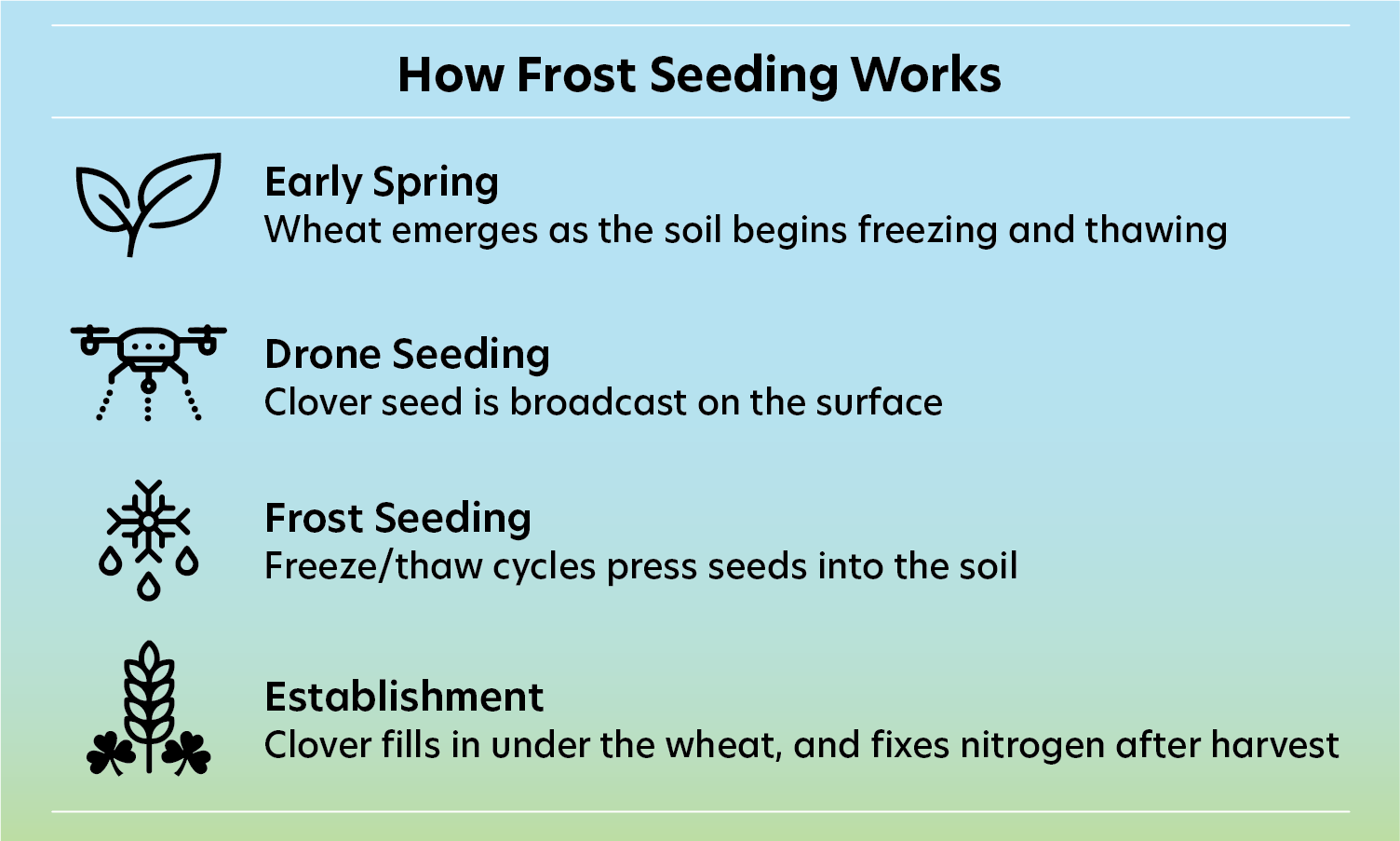
The wet, thawing, and muddy soil conditions of early spring that are perfect for frost seeding often spell disaster when trying to bring a tractor into the field to seed with an air seeder, or when using a side-by-side with a spreader in the back. Even if these vehicles can get in to seed, their tires may create compaction in wet soil. Drones have made what used to be an uncertain proposition a much more reliable practice.
As an organic farmer himself, Seth appreciates the improved accuracy he gets by seeding with drones. “If you're using a side-by-side/4-wheeler to frost seed your clover, you're going to be struggling with your accuracy and also your coverage between passes. There can be bare spots. But with a drone, it knows exactly where it is at all times so that the passes are perfectly overlapped, and the seed flow is closely monitored, so it’s even.” All this means that drones can achieve “very, very good coverage.”
While drones have changed the game for frost seeding, there are still issues to consider. The big thing is payload, because drones cannot carry near the weight of a tractor or sprayer. Clover seed is small and relatively light, but when seeding rates go above 25 pounds per acre, the drone has to return to base more often, which increases costs.
In 2025, Seth charged a base rate of $15.50 per acre for seeding rates up to 25 pounds per acre. Heavier applications for crops like rye take longer, so he charges a higher price per acre. While clover is a favorite, there are other cover crop species that drones are seeding into standing cash crops of corn or beans, such as rye or brassicas.
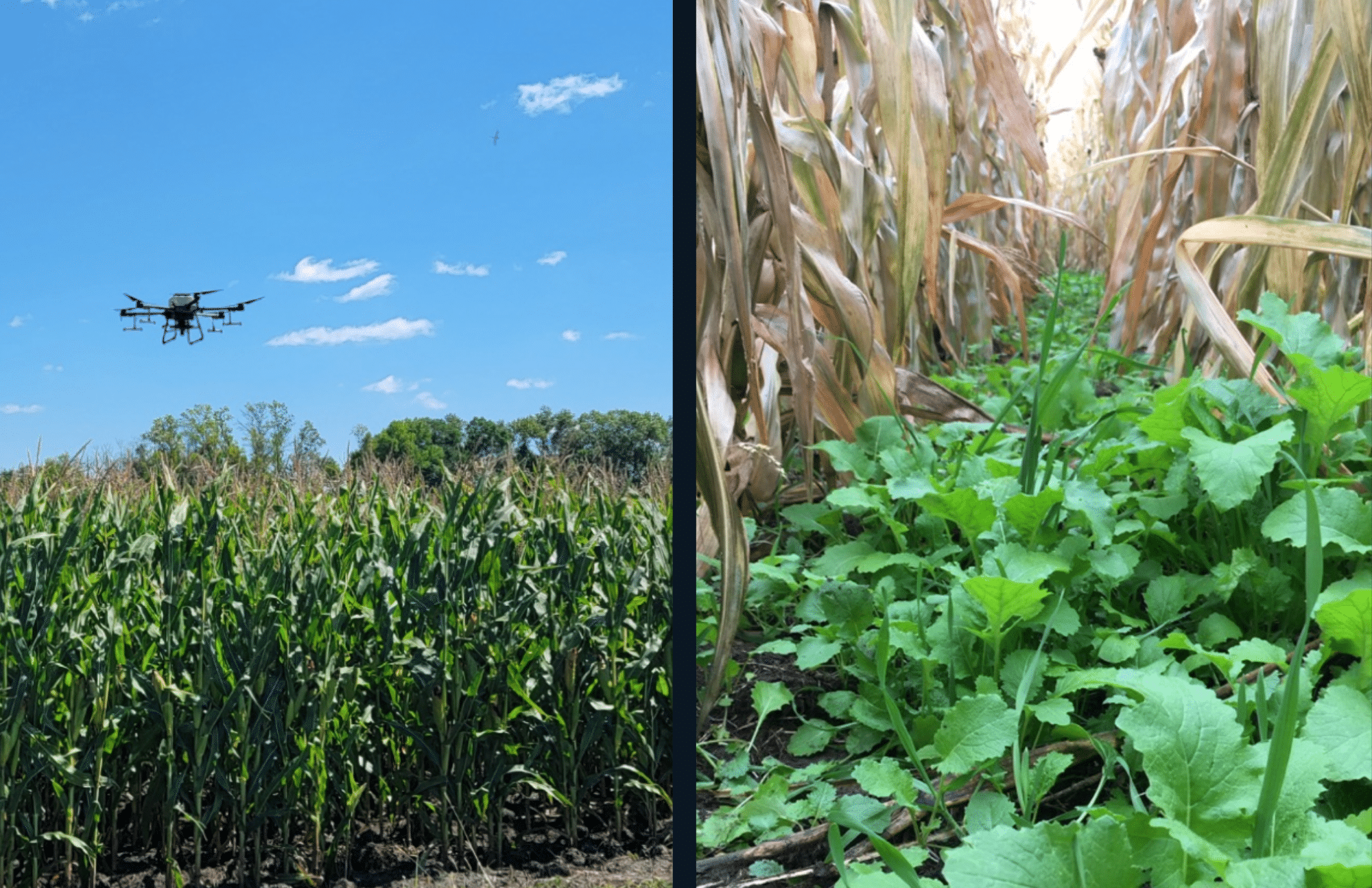
Photo: Drone seeding a cover crop into standing corn (left). Cover crop several weeks later (right). Photo courtesy of Crop Fertility Services.
Frost seeding is currently the biggest use for drones on organic grain, but they can also be used to apply organic fungicides and/or liquid fertilizers. Drones often do a better job applying sprays than ground sprayers do. This is because their blades agitate the crop leaves and blow the spray downward, which often means better leaf coverage. A variety of materials can be applied by drone. Organic farmers have asked Seth to apply some sticky organic materials like molasses. As long as the material can remain suspended in water for at least 10 minutes before settling out, many organic materials can be drone-applied.
While drones are often more accurate in spraying than ground sprayers, Seth warns farmers about drone pilots who push the limits of application and accuracy in order to increase their acres covered. “I have never run a 32 foot swath, because I've seen testing data showing that you cannot get accurate coverage at a 32 foot swath." Instead, Seth adjusts his swath width based on wind conditions to maintain accuracy. The widest swath he will run is 26 feet.
One drone job that we’re not seeing much of in organic is crop scouting. Although drones are commonly used for crop scouting in conventional fields, there are not many organic farmers using drones for scouting. This is because compared to conventional, organic growers cultivate fewer acres, and make more passes through the field at slower speeds, so they often have eyes on the crop throughout the season.
"If you're using a side-by-side/4-wheeler to frost seed your clover, you're going to be struggling with your accuracy and also your coverage between passes. There can be bare spots. But with a drone, it knows exactly where it is at all times so that the passes are perfectly overlapped, and the seed flow is closely monitored, so it’s even."
– Seth Hesterberg
In general, the ag drone scene is a bit like the Wild West, with technology changing rapidly and new, inexperienced operators coming in all the time. We all have to learn sometime, but you don’t want a new pilot learning on your crop.
Questions to Ask Your Drone Operator:
• How many acres have you applied?
• How many organic acres?
• How often do you do organic clean-outs?
• What is your clean-out procedure between conventional and organic materials?
If organic farmers want to hire an ag drone operator, timing is important. This is because as far as I know, in the Midwest there are no ag drone pilots who can make a living flying only organic acres; there just aren’t enough. Their main clients are conventional farmers, and they apply on organic acres when they have time.
In Illinois, conventional drone pilots tend to be busy from July 10th through August 10th, when Seth is applying conventional fungicides. Organic farmers often plant later than their conventional neighbors. Seth likes to work on organic farms in early August after the conventional rush. He appreciates advance notice so he can schedule multiple organic applications together to reduce the number of times he needs to do an organic clean-out of his spray rig.
Just a few years ago, drones felt like futuristic tech. Now they're solving real problems in organic fields, especially when spring mud makes frost seeding nearly impossible any other way. As more operators gain experience with organic systems and the technology continues to improve, it will be interesting to see what other challenges drones can help us tackle.
Want to learn more?
Penn State University shares their research, comparing planting cover crops into standing soybeans using drones and other methods - https://extension.psu.edu/what-weve-learned-cover-cropping-into-standing-soybeans
OATS published a video and factsheet on drones in organic ag - https://www.organicagronomy.org/resource-library/qp9zvu6dofmuyserz10vnaikqyxwcd
Farmers considering buying their own drone can learn from this publication that compares the cost of drone ownership versus custom hire - https://extension.missouri.edu/publications/g1274
Here you can see a video that shows the whole process of flying on a cover crop - https://www.youtube.com/watch?v=NNzTvX39zgU
Watch the complete OATS Organic Advisor Call Series discussion “Tech in Organic Row Crops” or listen to the podcast