Integrating Livestock Grazing on Grain Farms
Integrating livestock and grazing into a grain rotation
By Sam Oschwald Tilton
OATS Training Specialist and an Independent Organic Advisor at Glacial Drift Enterprises
Published September 22nd, 2026
I appreciate the simplicity of the soil health principles. It’s so nice to have a few basic sayings that can truly guide and improve soil management. While I’m quick to quote “keep your soil covered as much as possible”, I am less likely to talk about the benefits of “diversity on the landscape, like integrating livestock”, because I tend to think that it’s asking a lot of a farmer without livestock to bring them onto their cropland. It’s often fun to have my perspective shaken, and something else all of a sudden makes a lot more sense. So I enjoyed my conversation with two grain farmers who have been reaping the benefits of cattle on their cropland. I learned from both their own farming journeys and their specific livestock practices. Rather than viewing livestock as a secondary chore, both Clint Epley and Knute Severson treat cattle as the biological engine that drives their entire farming system.
Clint Epley grew up on his family’s farm in Pana, IL, which transitioned their 1,000 acres to organic in 1998. Clint now helps manage his family’s 3,000 acre organic farm, with his great uncle Jack Erisman, growing corn, beans, small grains, perennial forage, and an organic cow/calf grazing operation. Keeping animals on the farm has been an agricultural value since Clint’s great-grandfather.
Knute Severson is a fifth-generation farmer and rancher, and in 2017 he and his wife started their 100% grass-fed beef operation, Grand View Beef, selling direct to consumer. In 2025 they transitioned to organic. Direct-market beef growth has made animal integration an important part of their century family farm: diversifying crop rotations and reducing inputs, while increasing revenue.
On their farms, livestock synergize with grain production to improve yields of both and ultimately drive profitability. Given their passion, I wanted to understand the benefits of livestock and the details of what’s required for a farmer to integrate livestock into grain from scratch.
There are 3 main ways livestock integration complements grain:
Soil Fertility and Health
Labor and Machinery
Profitability
Soil Fertility and Health Gains
Integrating grazing allows farmers to shift from buying external fertility to actively building soil health and biology from within the farm itself. Cattle act as self-propelled, highly efficient manure spreaders. By grazing cover crops, forage, and cash crop residues, they immediately return those nutrients back to the soil in more plant-available forms. Livestock build up the “biological capital” in the soil. Following the soil damage inherent in cultivated row crops, farmers find that resting those fields by putting them into perennial forage with intensive grazing for 3 to 5 years makes big improvements to the soil. During this grazing phase, the soil builds up rich biodiversity and banks nutrients. When these acres are rotated back into annual crops, the soil’s fertility is ready to be “cashed out” to support high-yielding, high-quality grain crops without much imported fertilizer. This grazing-accumulated fertility translates directly into significant yield increases.
Because a soil can be fertile yet not healthy, other soil properties matter in addition to those shown on the chemical soil test. Properties like water infiltration, biological activity, and compaction can make or break yield. Cattle can improve the soil's physical structure. Because their hooves are designed to push into the dirt, they can increase water infiltration and work plant residue into the soil, where microbes and fungi can feast. In the wet spring months, this hoof action can also create a light crust that helps dry out the topsoil faster, allowing farmers to get tillage equipment and planters into the field earlier.
Grazing livestock generates specific fertility gains for grains:
At Grand View Beef, Knute’s acres rotating out of the 7-year grazing/forage cycle and into row crops consistently yield 20 to 30 bushels better for corn, and 10 to 15 bushels better for soybeans, compared to fields kept in corn-soybean rotations.
Epley Farm conducted a trial where cattle grazed cover crops over the winter before planting corn. Clint measured a 5 to 15 bushel yield increase in the subsequent corn crop where the cattle had grazed.
Labor and Machinery Savings
While it’s true there are serious labor needs with livestock, which I’ll get to later, there are also big savings. When grazing cattle distribute their own manure across fields, they spare farmers the labor, machinery, and fuel costs of manure spreading. With that manure and accumulated "biological capital” for the following cash crop, there is also a lot less fertilizer to buy and apply. And while watering cattle in the winter can be a pain, it also provides year-round work when the grain farm is slow, which helps farmers keep key employees. The cattle also give farm owners a better way to give employees a stake in the farm than with grains alone. Both Clint and Knute give key employees one animal each year. This goes beyond a simple cash bonus, it’s an investment in the farm and an asset that really grows. Clint says, "they can go out and count that animal, say: 'Hey, I've got ownership in this, and I've got equity,' and that gives them something more to go to work for every day."
Profitability
After a corn field is harvested for grain, there is a lot of residue left. A 200-bushel cornfield can produce around 2,000 pounds of residue per acre. Grazing crop residue and quick-growing cover crops like rye, which grow when no cash crop would, adds a lot more dollars coming off of each acre than if harvesting grain alone.
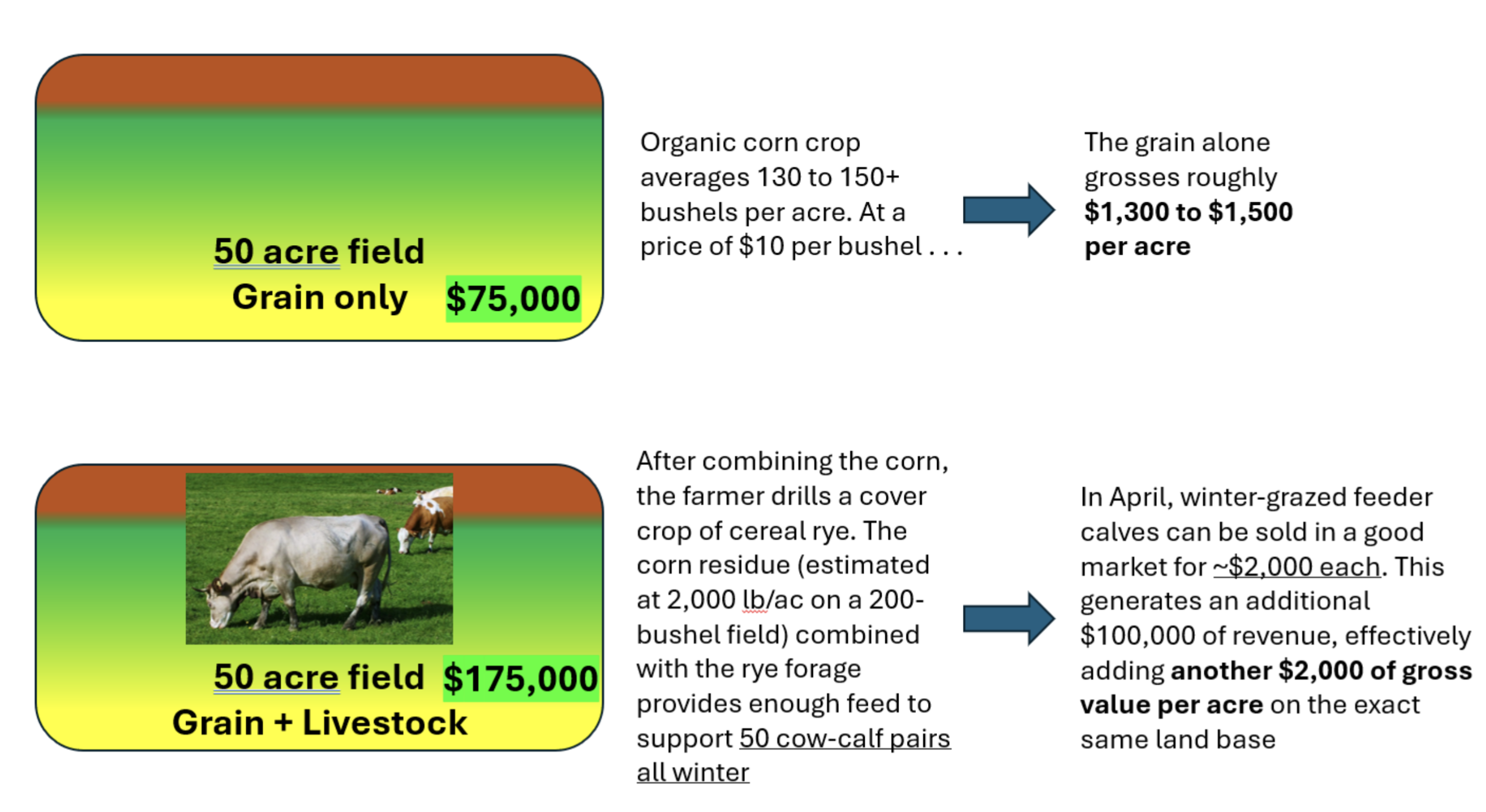
Livestock + Grain = Higher per acre revenues
Fencing
While cattle bring real benefits to soil health, labor, and profitability, they also require some real work. A big investment for farmers bringing cattle back on the farm is fencing. For security, farmers invest in higher-cost, more-effective high-tensile wire fences around the perimeter, either single or multi-strand, hot or not. Fencing for internal paddock divisions uses a cheaper single strand of hot poly wire that the cows are trained to respect. At scale, farmers don’t want to be rolling up temporary fencing by hand when it’s time for the cattle to move, so it’s helpful to have a hydraulic winder on the back of the tractor. Just like in the rest of agriculture, technology is making big changes, and the cost of GPS collars has dropped a lot in recent years: from $300 to $90 per unit. And annual software subscription fees have gone from $10,000 to $800. While new, a lot of farmers and ranchers are excited for the new capabilities GPS collars will bring.
Water
After fencing comes watering, and it’s often the single biggest bottleneck when introducing livestock to grain fields, as most of them are far from hydrants, and it can get a lot more "interesting" in the winter. Watering systems are one of two types: either piping or hauling.
Some farmers want to invest for the long haul, because water delivered in buried pipes to frost-free hydrants is more reliable and less hassle than hauling. Water can be piped from a single source or be decentralized by tying into any older wells near each field. During dry times and when well-levels drop, some supplemental water may need to be hauled.
But many growers are trying out cattle or don’t want to invest so heavily right away in a piped system. For them, hauling water is a good fit. The more water you can haul at one time, the better, so a farmer might turn a grain truck into a watering rig. Knute put a 2,000 gallon tank on a grain truck, with 3-inch piping and 300 feet of hose. This means that he can water cattle within 300 feet of a tank.
Whether piping or hauling, the real challenge with watering is winter’s cold. A larger volume of water takes longer to freeze, so larger tanks are preferred (~700 gallons), rather than smaller automatic waterers. Also, automatic units can cause cattle to shove one another away, whereas large-volume tanks allow the entire herd to gather and drink their fill at the same time. It takes creativity to prevent frozen water; here are two good ideas:
Geothermal tank heating: To prevent frozen tanks without using electricity in distant fields, farmers can heat water with the earth. Utilizing natural ground warmth with systems dug in a day with a backhoe, these systems can operate for 15 years without freezing solid. They do require a light chipping of surface ice in sub-zero weather. Learn more here.
The winter drain technique: On remote crop fields without active water systems, farmers can water with the sun, by filling the tanks at 10:00 AM (the warmest part of the day), allowing cattle to drink, and then pulling a quick-release plug at 2:00 PM to drain the remaining water, so that the tank can’t freeze solid overnight.
Grazing Management
Once farmers make plans for fencing and watering, then comes the fun of moving the cattle on the agricultural landscape and growing feed. Farmers look for places throughout their rotation, in both cash and cover crops, to get animals out grazing. Grazing annual cover crops on row-crop ground allows farmers to stock animals at densities that would quickly destroy permanent pastures.
Cover crops follow small grain harvest: Knute utilizes the window after the July small grain harvest to drill a highly diverse cover crop mix (sorghum-sudangrass, millet, turnips, radishes, rapeseed, and sunflowers). In wet years, this forage grows 6 to 10 feet tall. By shrinking his paddocks down, Knute heavily stocks these high-tonnage annual covers.
Corn stalks and cereal rye: Clint Epley uses a winter grazing strategy that combines crop residue with winter cover crops. After combining corn, he drills cereal rye. Over the winter, cattle graze on corn residue and green rye forage.
The intensity of a grazing strategy is directly tied to the type of cattle and changes with the seasons. Steers that are finishing on grass get intensive grazing.
Early season green flush: During the rapid spring forage growth, cattle are moved every 2 days, at a density of 125 head on 5-acre paddocks.
Late-summer slump (August): As steers are harvested and the herd size shrinks, stocking density is reduced, leaving a smaller herd of 50 head on a paddock for a full week.
Late-season regrow: The paddock is left completely idle for 45 days, to allow the forage stand to fully recover and regrow.
In contrast, cow-calf herds require less intensive nutrition than grass-fed market steers. For cow-calves, farmers tend to utilize larger paddocks and a more relaxed rotation, rotating every week or so. Permanent pastures are rotated strictly during the summer and fall and are left untouched during the winter to avoid cattle damaging the sward.
The most critical grazing strategies are not about where to put the cattle, but rather when to take them off to prevent damage to the stand or the soil. There are some common timing rules to protect forage and soil:
Wet spring danger: Be cautious about turning cattle onto greening pastures too early in the spring, when the grass is only 3 to 4 inches tall, because grazing wet, shallow-rooted spring grass will severely damage the forage roots and reduce production for the rest of the year. Instead, wait until a cover crop is 6 to 8 inches tall and soil is drier before turning the herd out to graze.
Wet fall danger: When grazing harvested row crop fields in the fall, cattle must be pulled off the field before the ground gets too wet, because failing to do so causes severe hoof compaction that can reduce grain yield the following year.
Leave something: A common beginner mistake is turning cattle out when cover crops are too short, and then leaving them grazing down to bare soil; this destroys a forage planting and damages soil.
Beginners have a lot to learn about rotating grazing cattle and how to integrate that labor into the schedule. It’s helpful to have a "Gateway Drug" practice for beginners that is somewhat fail-safe and allows time to observe and learn. For grain farmers who are curious about livestock but intimidated by the intense labor of daily cattle moves, consider a low-risk transitional grazing strategy:
Larger Paddocks with 2-to-3-Week Rotations: Beginners can start by establishing larger paddocks where the cattle are only moved once every 2 to 3 weeks. This significantly reduces daily labor demands and allows the farmer to learn cattle behavior, get a feel for forage recovery rates, and capture the biological benefits of animal integration without the steep learning curve of daily mob-grazing moves.
I used to have a “grain-first mindset”, where I thought of livestock as complementing a grain farm. But after learning from Knute and Clint’s farms, I started to see that they turn that traditional grain-first mindset on its head. Because of the profitability and soil-building attributes of their cattle, these farmers see themselves as livestock producers first, who use short grain phases of their rotation to “cash out” fertility built up by grazing and periodically reset their pastures. For them, beef represents their most profitable crop, with grain playing a supporting role.
Want to learn more?
Watch the full Organic Advisor Call Series conversation, “Integrating Livestock Grazing on Grain Farms" on YouTube