Managing Perennial Weeds
Rotating Out of Perennial Weeds in Organic Grain
By Sam Oschwald Tilton
OATS Training Specialist and an Independent Organic Advisor at Glacial Drift Enterprises
Published September 15th, 2026
Perennial weeds can be a pernicious problem when they get into organic grain fields. Whereas annual weeds can be reliably killed with tillage and the slate wiped clean with a pass of the field cultivator or speed disc, perennial weeds don’t go down that easily. In my experience, managing them well requires a multi-year strategy that uses tillage, timing, implement adjustment, and other field operations to target specific perennial weeds. Simply put, managing perennial weeds tends to require more thoughtful strategy than annuals. I always enjoy talking and learning about weed management, so on a recent episode of the Organic Advisor Call Series I was happy to speak with Farmer Will Glazik and Ag Researcher Dr. Patt Carr about their experiences dealing with perennial weeds.
When I am figuring out a weed problem, the first thing I want to do is “understand my enemy”. I want to know, of all the “weeds” out there, why is this one growing so well? And why is it so hard for me to control? Seeking first to know the weed species helps me identify crucial details and see the big picture. As Saint Francis would suggest, I want to seek first to understand. When I do this with common perennial weeds, their shared traits stand out.
Plants like Canada Thistle, Field Bindweed, and Perennial Sow Thistle are tough as weeds for good reasons:
They have very deep roots, going down 6 to 30 feet - no human-made tillage tool is going to touch that!
Those roots are like batteries that are charged up with starch after a full season and ready to see the plant through winter. These energy reserves can also power the root pieces through tillage passes and allow them to resprout.
They can spread from the roots as well as by seed, so it’s not good enough to just prevent them from setting seed, like with annuals.
There are no organic herbicides that are absorbed into the plant and translocated to kill the roots. They are contact herbicides, which may work on annuals, but won’t kill perennial roots.
When a problem shows up in-season, for a lot of farmers tillage is the first tool at hand; whether it’s because there are only a few weeks to fit the land for planting, or maybe the corn is already planted and now the only option is cultivating out a perennial weed. Cultivating out perennial weeds is not a position anyone wants to be in, because the cultivators don’t kill them, they just cut the shoots. It can especially be a pain with Bindweed, where the vines can plug up cultivators. A good option for Bindweed is a high-residue cultivator. It has a cutting coulter running in front that splits residue and one single wide sweep between the rows. The single sweep clears residue much better than a low-residue cultivator with Danish S-tines, where the 3 or 5 smaller overlapping sweeps can all plug up with residue, especially when the sweeps are arranged to funnel residue into the row middles instead of the crop row.
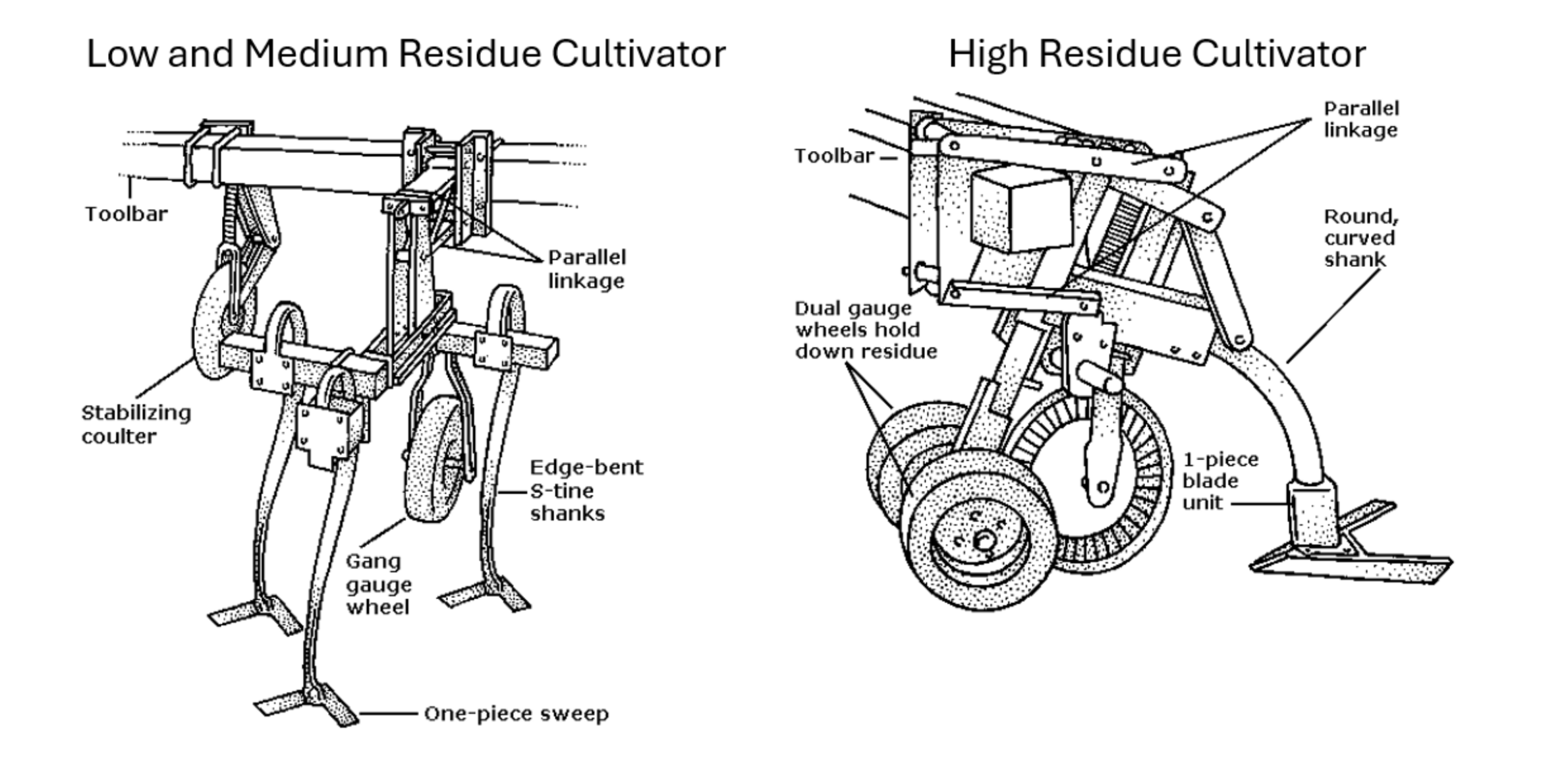
The right tool for the right job
When creeping perennial weeds, like bindweed, are growing with row crops, a high-residue cultivator can do a better job.
Credit: Steel in the Field, by Greg Bowman
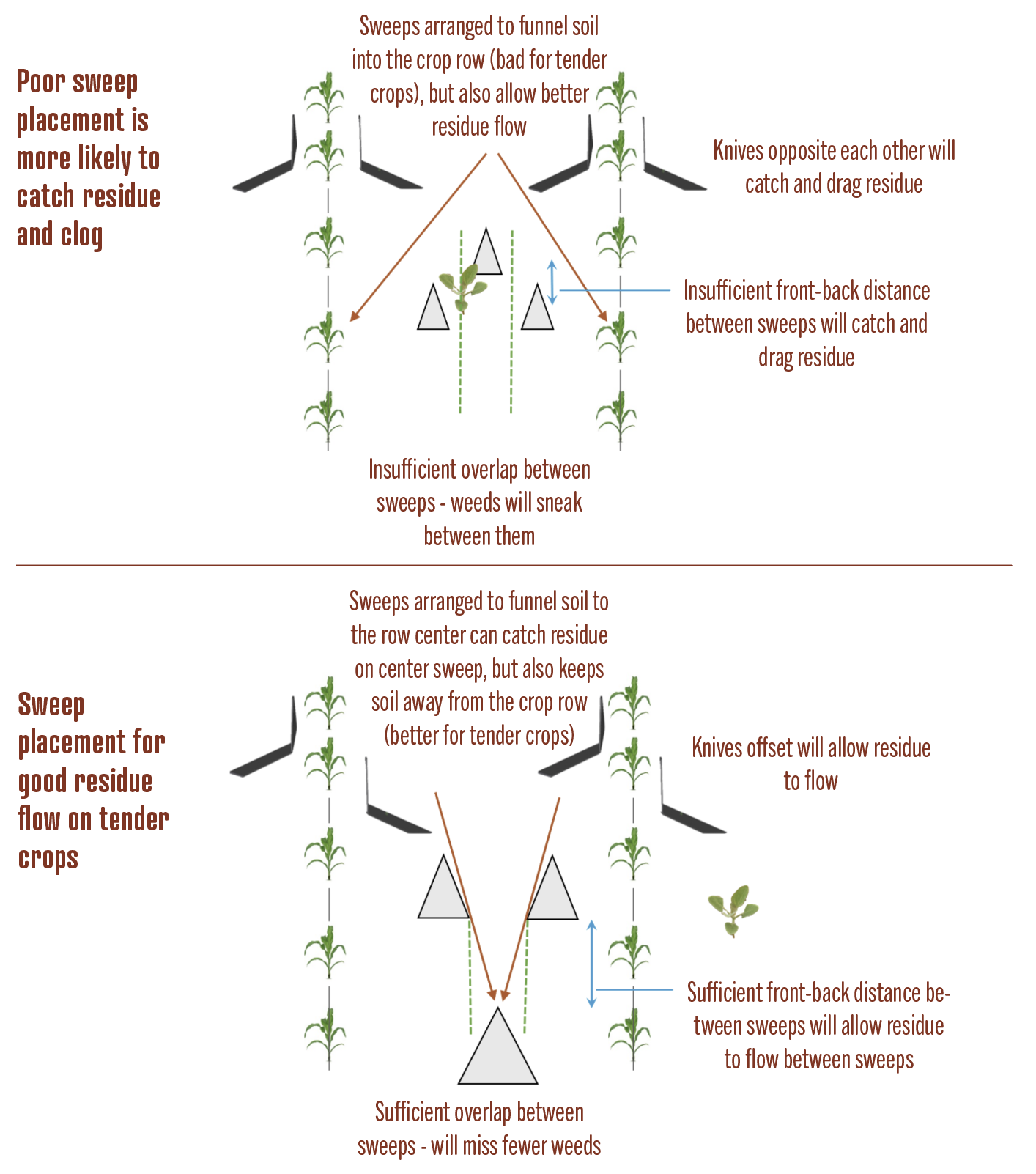
Mind the residue flow
On a low-mid residue cultivator, sweeps can be arranged to funnel residue into the row so that the cultivator clogs less.
Credit: Diagram by Sam Oschwald Tilton, courtesy of Cropline Equipment’s Weed Management and Cultivation Handbook
Cultivating a growing crop is usually not going to allow a farmer to control perennial weeds long-term, it’s just going to set them back enough to make a crop, hopefully. But after the crop is harvested, it can be a great time for using tillage to manage perennial weeds. When there is an opportunity to do full-field tillage, as opposed to cultivating between rows, farmers can maximize the opportunity by choosing tillage to target specific perennial weeds. The time for this might be after harvesting small grains or when hay/pasture land is being transitioned for grain.
On his farm in Illinois, Will Glazik finds that very dry soil conditions make his plowing extra effective against Canada Thistle. “On hay/pasture land that is coming into corn, we try to do our plowing for that in August/September, and get a cover crop on it before going into winter. We’ve found that if the soil is quite dry, when the plow goes through it will pull up entire strands of thistle roots. But if the soil is wet, the roots are cut rather than pulled. When we hit a thistle patch, the roots get laid out on the surface and baked in the sun.” Will found that in trying to plow 4 to 6 inches deep in hard soil, the plow shares had trouble staying in the ground. He found that putting deep suck plow shares on each bottom allowed them to penetrate the hard ground, when conditions were perfect for pulling up thistle roots. Outside of dry summer weather, there is another time when tillage can do real damage to perennial weeds by targeting a weak point in their lifecycle.
One of the benefits of “knowing your enemy” is identifying the weakest point in the species’ lifecycle. For many perennials, that is late spring to early summer. If the roots of a perennial weed are like a battery, by the end of the fall it is all charged up and ready to power the plant through winter. But by the end of winter most of that juice has been used up, and then the final reserves are used to push out the first stem and leaves in the spring. For example, with Canada Thistle, science tells us that the shoot does not begin charging up the root again until it is more than 1 foot tall. This 1 foot height is called the thistle’s compensation point, and each perennial weed has one.
At that point in time, the roots are at their weakest, having not been charged since the previous fall, and tillage will do the most damage. If farmers can spare the time in the spring, a few tillage passes about 3 weeks apart are ideal. This is because the roots will only die once they’ve exhausted all their energy. Even if a tillage pass is done right at the compensation point and the roots are cut into pieces, they still have energy to resprout. After that first tillage pass, farmers WANT the root fragments to resprout so that they use up more energy; then, with a second tillage pass the root’s energy is very much depleted.
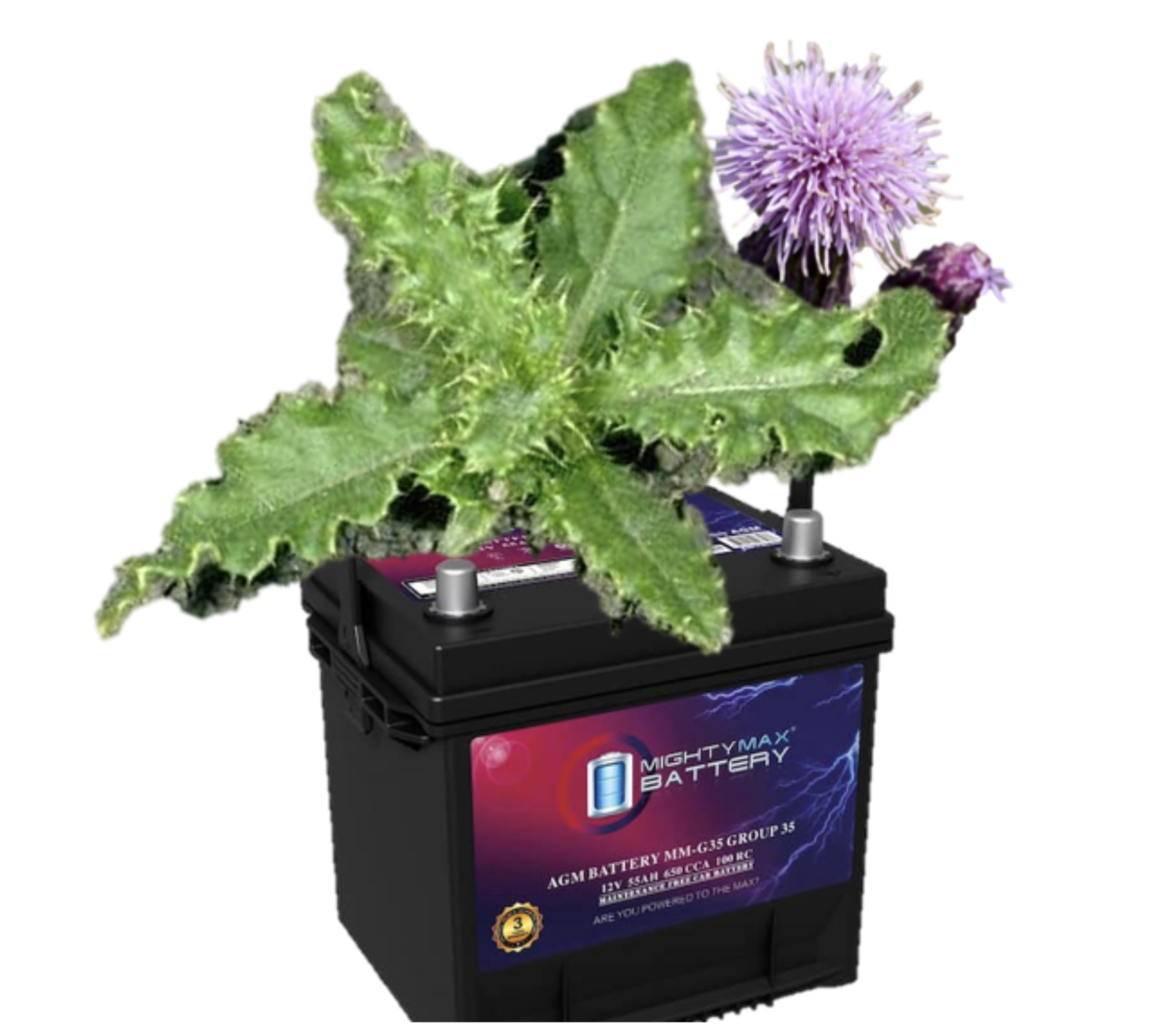
Perennial weeds are a battery
Think of perennial weeds as a car battery - with roots that are charged up every summer from solar panels (leaves), and then that charge is drawn down over the winter keeping the root alive, and depleted even more in the spring from powering the growth of the first shoots.
These tillage passes done with the right tool and at the right time can really set perennial weeds back. But they will only manage them, not eliminate them. Oftentimes that management can be good enough - so that year after year patches are getting smaller and not spreading. Many organic farmers choose a strategy that manages perennial weeds rather than eliminates them. That’s because while eliminating perennial weeds organically can be done, it typically takes at least 2 years and with long fallow periods of tillage every 3 weeks. For most organic farmers, that juice is not worth the squeeze.
But in addition to tillage, farmers can use their crop rotations to help manage perennial weeds. A season of a vigorous annual forage crop that is repeatedly mowed, like sorghum/sudan, can set perennials back - getting mowed every time they try to grow depletes their energy. Short-season crops like buckwheat or early soybeans allow a crop to be taken off before perennials have grown too much, and they give a window for a few tillage passes before the next cash or cover crop. Two or three seasons in grazed or mowed alfalfa will set perennials even more. Cattle can also be fenced in on perennial weed problem areas, to graze young growth and stomp older plants before they set seed.
Because perennial weeds spread by seed as well as root, it is crucial to prevent flowers from setting seed. So there are times when weed flowers need to be mowed before they set seed. This can be tough when a dense stand of flowering thistle is growing within cash crops - sometimes it’s a good thing for farmers to mow problem areas of the cash crops to save the land from a crop of perennial weed seeds.
Farmer Will Glazik sees all these tillage tools, timings, and crop rotations as opportunities to reduce perennial weed patches. But he’s realistic in aiming for management, not elimination, especially because in his diverse rotation, there are years when perennial weeds will retreat, but then generally they will flourish during row crop years when he can only cultivate between rows. After a few years in hay or pasture or grazing, “then, usually it's suppressed enough that we can raise a corn and soybean crop, and then during that time, they're going to kind of reinvigorate a little bit, come into the small grains, and then we'll try again.”
Whatever level of management you are aiming for, a good practice with perennials is mapping - if you don’t know what you have and where, you can’t keep on top of it or strategize to control it. Most important is getting out of the tractor to learn about the weeds - where the extent of the problem, can you identify where it started, what stage are the weeds at in their lifecycle? Farmers can make maps on paper or computer based on their field observations, and that allows them and their advisors to track perennial weed issues over time. Drone and satellite mapping of weeds is also coming into its own. Dr. Carr explained that cameras can be trained to “see” the light wavelengths reflected by individual weed species, and this is only getting more accurate over time, and is likely a service that drone operators and agronomists (will soon) offer.
Perennial weeds can be a real pain to organic grain growers because they are a double threat - spreading by roots and seeds! But when we take time to understand our enemy, we can identify the following:
Tillage implements
Implement adjustments
Tillage timings
Tweaks to our crop rotation
All of which can allow for a realistic level of weed management that may not eliminate perennial weeds, but provides enough control so that they don’t impact yields or quality.
Want to learn more?
Watch the full Organic Advisor Call Series conversation, “Managing Perennial Weeds" on YouTube