Tips for Growing and Maintaining Quality Grain
Tips for Growing and Maintaining Quality Grain: From Planning to Production, Storage, and Marketing
By Sam Oschwald Tilton
OATS Training Specialist and an Independent Organic Advisor at Glacial Drift Enterprises
Published September 8th, 2026
As I talk with organic grain farmers throughout the season, it's clear how much work and worry go into raising their crop. It's a shame when the grain from those long days turns out lower quality than expected, resulting in a smaller check. Food-grade grains pay a higher premium but require corresponding quality. For farmers selling food-grade, a bin-busting year doesn't mean as much if the quality of what's filling that bin is low. And on the flip side, when a farmer produces a high-quality crop, we want them to get paid for it. But that means they need to know what they have and communicate it to their buyers through accurate sampling. Throughout the entire cycle of production — from winter planning, field selection, and crop rotations; to planting, field scouting, and harvest; and finally storage and marketing — there are many places where grain quality can be built or destroyed.
I wanted to learn more about the big picture of making and maintaining grain quality, and a veteran organic grain farmer suggested I speak with Curt Petrich. Curt visits a lot of organic grain farms as the Owner and Partner of HC International, Inc., which specializes in marketing identity-preserved soybeans and whole grains for domestic and international sales. He's been in food-grade grains for years, previously as VP of operations and then VP of international sales for organic companies. He's also held numerous industry leadership roles, like chair of the Northern Food Grade Soybean Association. Curt, I found, was a person whose wide and deep industry perspective shone the perfect light on the cracks where grain quality can break down.
Quality Starts in the Winter
Farmers can plan for quality in the winter by tweaking their rotation and field locations towards quality. Farmers who contract their grain before planting should take the time to understand the buyer's quality requirements and the specific specs they have. It's common that food-grade buyers will have production suggestions or requirements for growers. They may want to verify the previous crops on a field, sometimes looking back two full years. Farmers selling on the open market (without a contract) should actively research the varieties and crop histories the industry wants, rather than planting first and just taking whatever price the market will give them after harvest. As Curt put it, “Before you maintain spec, you need to know what the spec is you're maintaining.”
In thinking through rotation and field history, farmers and buyers want to avoid contamination from past cash crops.
Often the contamination culprits for beans are volunteer corn or the beans of years past:
Volunteer Corn: A major rotational hazard is volunteer corn emerging in a food-grade soybean field. At soybean harvest time, volunteer corn is often immature, round, and light yellow, which all mean it can easily pass through a combine and precision cleaning equipment. Food buyers have an almost zero tolerance for this, as stray corn can end up ruining end products like tofu or natto.
Edible Bean Contamination: Planting food-grade soybeans up to three years after a crop of edible beans is risky, because edible beans often leave behind hard seeds that sprout as volunteers in subsequent seasons. Many food-grade buyers have extremely low thresholds for these contaminants because they are highly difficult to separate.
Scouting
After off-season planning, the game begins to produce quality grain, and field scouting is a good first step. Farmers can be out scouting to confirm that the GMO buffer strips are still adequate to prevent contamination through pollen or herbicide drift (for corn, planting later than neighboring conventional fields will help with GMO pollen drift). They can also look for field factors that could make harvest hard or reduce quality, such as the gopher mounds, which can pull dirt into the grain when the combine head hits them during harvest. Foreign matter, like dirt, has knock-on effects. Harvesting a gopher mound can make that one load dirty, but then putting one dirty load on top of nine clean loads instantly compromises all ten loads.
Curt points out, “You cannot blend up in this business. Anytime you put something that's sub-quality into quality, you have lowered the total quality. If you put one bad load on top of nine good ones, you've just now moved that bin into a lower-quality category.”
Once crops are growing and harvest nears, we can scout the crop for problem areas. Harvesting diseased grain, immature grain, or weeds can all lower quality and risk hot-spots later on in storage. If white mold is serious in beans, those areas are best left unharvested for food-grade. Similarly, areas where the crop is slow to mature can be harvested later. Curt says, “If 90% of the field is ready to go, harvest 90%.... Come back and pick up the rest later, when it's mature.” Areas that have dense weeds will be a pain to combine, and the big risk is picking up weed seeds. Although they can often be screened out later, if green weed seeds remain in stored grain they can heat up, ferment, and cause “hot-spots” that ruin the grain around them in the bin. Larger-scale farmers may find that field/crop scouting with a drone is helpful. When farmers identify areas of poor quality, those areas are not a total loss; instead they can be harvested separately and sold for feed at lower quality.
Harvest
Farmers often time harvest by scrutinizing the moisture level of the grain in the field, since it costs money to dry grain that is too moist. When harvest starts, operators must be mindful of their combine settings, which are particularly important for crops susceptible to damage, like food-grade soybeans with delicate seed coats. If the grain coming out of the combine suddenly stops looking clean or has cracked seed coats, the operator should stop immediately and investigate the cause. Many grain buyers have recommended combine settings for the crops that they buy, and they gladly share these with their producers.
A frequent and costly mistake is attempting to harvest uneven fields with the assumption that green, high-moisture grain will simply “blend off” or mix evenly with dry grain. In reality, high-moisture grain does not spread out; it cakes together in the combine and doesn't flow properly. When transferred to a bin, this wet grain creates localized “hot-spots” that lead to mold and heat damage. Because this damage spreads, a small clump of wet grain will ruin a much larger radius of the stored crop.
Filling Bins
Filling bins should not be as simple as it sounds. Farmers want to be continually assessing and improving grain quality when filling bins. Investing in a rotary screener to clean the grain before it enters the bin is a crucial step in maintaining quality. If farmers wait to clean their grain until they are shipping it out, they are asking for quality issues, because foreign material (FM), dockage, pods, and weed seeds in the bin all restrict airflow and drastically increase the likelihood of insect infestations and heating issues. Taking the time to clean grain before it goes into the bin can be a pain, but as Curt says, “It's either the pain of discipline or the pain of regret. The pain of regret is way more expensive than the pain of discipline.”
Sampling
In addition to cleaning, the other important part of filling bins is accurate sampling of what is going in. Every truck coming out of the field is carrying a unique load. To accurately know what is going into storage, the person unloading the truck must pull small samples from every single load as the bin is filled. Once the bin is filled, these smaller pulls from each load can be mixed together into a bucket to create a truly representative composite sample of the bin's contents. Relying on a single sample taken from the top of the bin after it's filled doesn't tell you what is in the bin. That would be like measuring 5 grains of sand from a beach and saying you now know about all the sand on the beach, when all you really know about is those 5 grains of sand.
As they are filling bins, farmers can use an accurate sampling program, so that they know what is in their bins and can communicate clearly with their buyers:
Take representative samples from trucks as the bin is being filled.
To be accurate, pull several samples from each truckload. The goal is 1 gallon of grain per truckload, pulled from different parts.
Once the bin is filled, mix all those truckload samples together into a single 5-gallon pail.
Don't hand-clean samples before sending them off for analysis, because buyers want a sample that represents the grain they will be getting.
The total volume of the collected sample should scale with the size of the bin: a 5,000-bushel bin requires a 3- to 4-gallon sample, whereas a 10,000-bushel bin requires a full 5-gallon bucket.
Yikes! Make sure the 5-gallon pail is clean. You may be surprised by the number of times Curt has received grain samples in buckets that were repurposed from holding hydraulic fluid. Dirty buckets do not make accurate samples.
Always save part of each sample yourself and store it in a cool, dry place, so that if discrepancies arise (which happens), you can refer to it.
Send off a representative sample from each bin to have it graded. Your food-grade grain is highly valuable, so don't take it to the local elevator for their unofficial grading; instead, send it to a grain inspection lab certified by USDA.
You now know what is in your bin.
Sampling is so important that many buyers send out sampling instructions and sometimes sampling kits every year.
Bin Management
While accurate samples are important, maintaining quality grain takes more than just that. Before bins are filled, farmers can reduce storage issues by cleaning and removing old grain, sweeping walls, and cleaning air floors and sumps. Once grain is in the bin, the primary goal of bin management is to cool down the grain as quickly as possible. In northern regions and the Midwest, cold weather tends to cool down bins quickly. This quick cooling slows deterioration, preserves a fresher quality for the market, and either kills insects or forces them into a dormant state.
In storage, farmers are always trying to keep grain from heating up, and aeration is key for this. Farmers need to actively monitor this process. Assuming that simply running air will automatically dry out high-moisture crops without careful supervision can result in the top several feet of the bin turning to junk. The physical shape of the grain mass will influence how well air can flow through it. A leveled bin is far better for aeration than a peaked bin. Even better than a leveled surface is pulling a load of grain out of the center to create an inverted cone (called pulling the core). This shape makes the entire bin's environment easier to manage.
The biggest area where problems develop is along the bin walls, known as the side-wall effect. Environmental control becomes particularly difficult during seasonal transitions. For example, in March, bright sunlight can heat the exterior bin walls to 60 or even 80 degrees, while the outside air and the internal grain are at 20 to 30 degrees. This temperature differential creates condensation, which leads to mold growing along the bin walls. This issue is even worse when the grain was not pre-cleaned, because lightweight pods and foreign material naturally migrate and collect against the bin walls during filling, restricting airflow exactly where it is needed most. To manage this, farmers can maintain good aeration, pull loads out, and pre-clean the grain before storage to ensure air can freely circulate against the walls.
Good bin management is also the primary way to stop the spread of live toxins. Vomitoxin (a toxin produced by mold) is not static. Just because you put in grain with low vomitoxin doesn't mean that is what you will pull out in several months. Vomitoxin can multiply if the bin environment remains warm and humid. For example, a warm, humid fall makes it harder to adequately cool bins down, which can cause the vomitoxin levels to double, jumping from an acceptable 1 part per million up to 2 or 2.5 parts per million in a few months.
Curt emphasized this point many times: “Every grower should know what they have in the bin. If you don't know what you have in the bin, how do you sell it, and how does a buyer know what they are getting? Knowing exactly what is in your grain bin is like knowing what is in your retirement account; if you do not know the exact specifications of your grain, you cannot effectively value it, work with lenders, negotiate with buyers, or manage storage risks.”
Marketing
Despite a farmer's best intentions and planning, we all know each season has its own surprises. Farmers cannot be certain in winter or spring what the quality of their grain will be at fall harvest. For this reason, it can be difficult for farmers to negotiate a contract months before harvest, when the final quality at that time is completely unknown. If farmers sign a contract for a certain spec but deliver something below that spec months later, they can incur big discounts upon delivery. Instead, farmers may want to develop a relationship with a buyer, be aware of their specs, plant the varieties the buyer prefers, and wait to sell until after the crop is harvested and its quality is verified. Selling once the quality is known allows farmers to sell their grain on its real quality, even if it means missing out on early pricing opportunities.
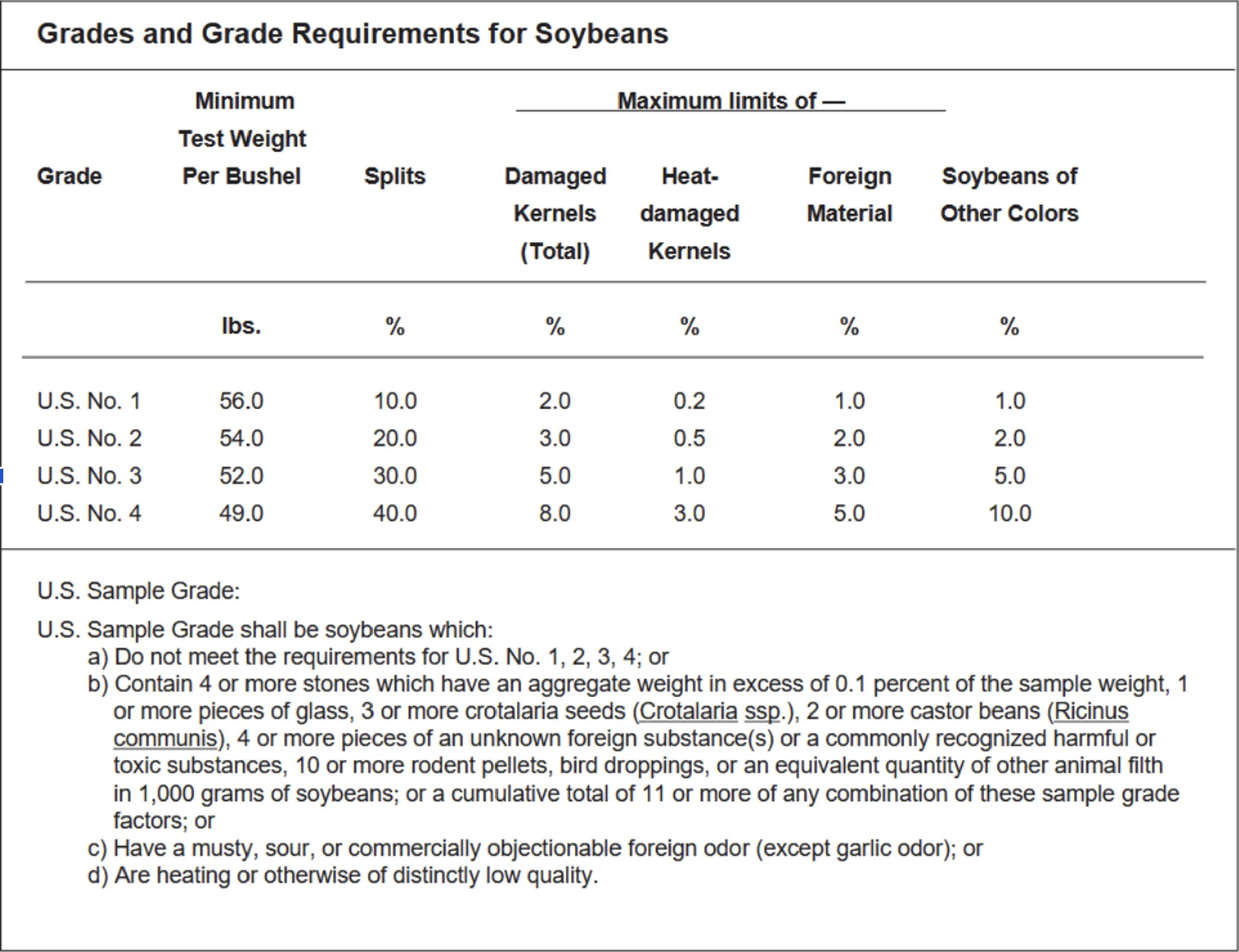
Citation: USDA soybean standards (https://www.ams.usda.gov/sites/default/files/media/SoybeanStandards.pdf)
Want to learn more?
Watch the full Organic Advisor Call Series conversation, “Meeting Spec: Maintaining Quality in Stored Organic Grain" on YouTube