
Scouting Stands for Replanting Plans
Scouting Stands for Replanting Plans: How to Make the Decision to Replant Corn and Beans
By Sam Oschwald Tilton
OATS Training Specialist and an Independent Organic Advisor at Glacial Drift Enterprises
Published September 1st, 2026
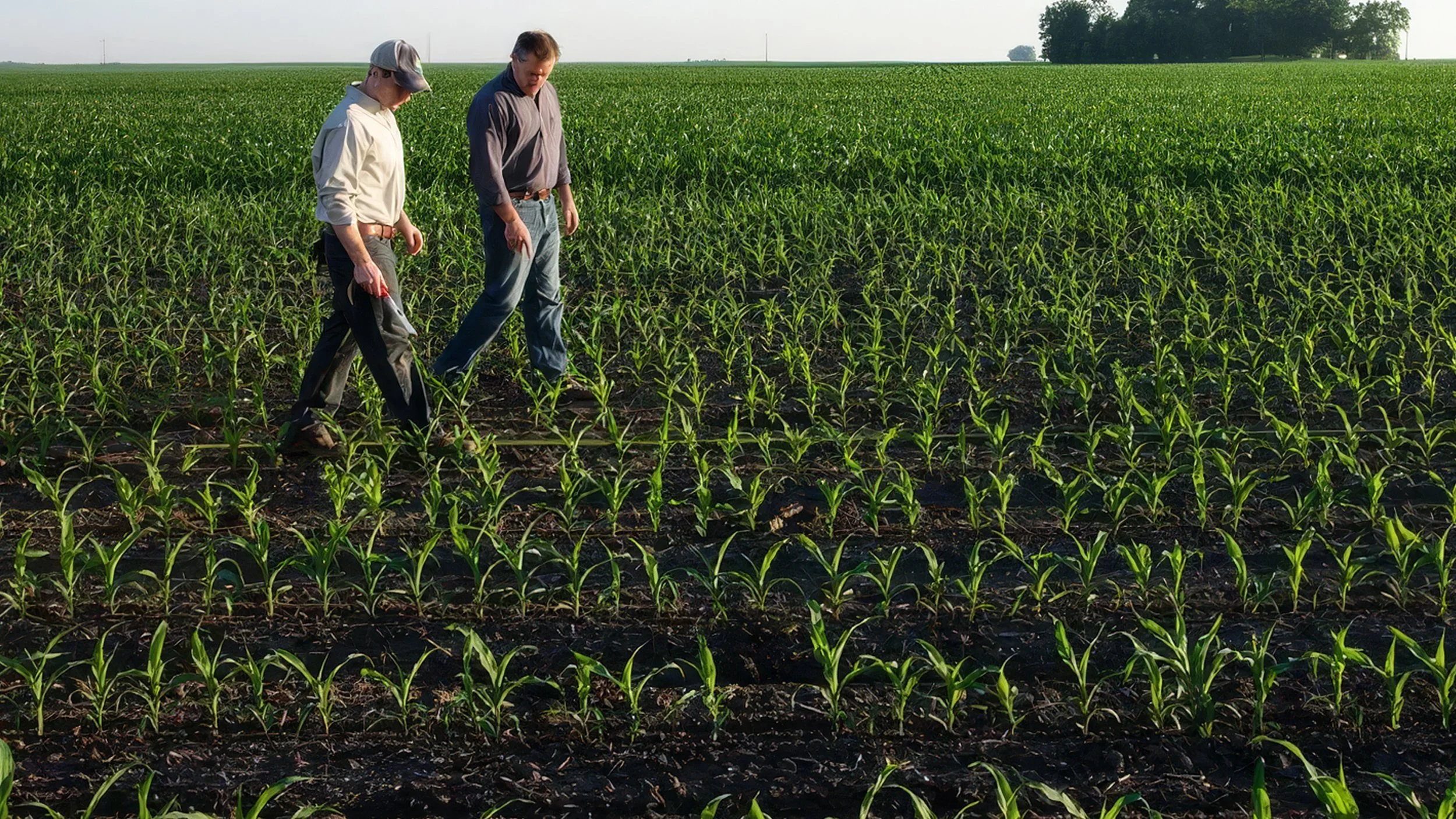
Farmers make so many decisions to get planting right: checking the weather and soil moisture, and choosing a planting depth and plant population. But despite their best efforts, not every field comes up great. And when they don’t, it can be tough to decide which fields need replanting. On the one hand, replanting takes time and money, and the replant won’t have as long to grow. On the other hand, a weak stand can be a headache all season long, because in organic we rely on a thick stand to outcompete weeds. Farmers and their advisors need to scout fields in the few weeks after emergence to understand plant population and weed pressure in order to make decisions about replanting, and there can be a lot of factors to consider.
I appreciated a recent episode of the Organic Advisor Call Series, where I sat down with Aaron Vercler, Ross Wilkin, and Hans Bishop — all central Illinois organic grain farmers. We talked through their experiences to sort through the details and also the big picture of replanting, and I’m happy to share some highlights here.
Reasons to Replant
There are two main reasons organic farmers replant:
Weed pressure
A poor stand (low crop density)
For organic field crops, the main challenge is weed control. And one of the biggest tools is a healthy, dense crop that outgrows weeds and shades them out as the season goes on (with a little help from weeding tools). If a farmer calls me out and we’re looking at a weak stand, sometimes even the best cultivators are not enough to rescue that crop. The two should work in partnership: a dense, vigorous crop with timely cultivations. Organic farmers often plant at a higher density than conventional recommendations (5–10% more) to account for cultivator blight and because a dense stand is so crucial. But sometimes, despite best efforts at planting, emergence is poor.
Weed density is the other reason to replant. Without herbicides, organic farmers try to reduce weed populations over time using their rotation, intelligent tillage (implement, timing, and setting), stale seedbeds, timing planting to avoid problem weeds, and in-season cultivation. As long as the crop is bigger than the weeds, a wide variety of cultivation implements can be used to kill weeds and preserve the crop. But sometimes a dense carpet of weeds emerges right along with the crop, and these are hard to cultivate out. This can especially happen with rain after planting, when it’s not possible to get into the field for early cultivations. Farmer Aaron Vercler says, “The goal is to start clean and stay clean, because a thick stand sure forgives a lot of other sins. If the weeds are very dense or a similar size as the crop, then I’m already starting behind the eight ball.”
Poor stands are often caused by:
Soil crusting
Rains after planting can cause the soil to crust and seal, which reduces oxygen in the root zone and makes it physically hard for plants to emerge
Seed corn maggot
Cold, rainy weather
Poor crop emergence
Ponding
Fields and field areas in lowlands can pond with excessive rains after planting
Frost
Rare, though it happens
Decision Factors
At some point, the rubber meets the road. The clock is ticking, and the decision needs to be made on whether to rip it out and replant or ride that stand for the whole season. Farmers tend to prioritize weed pressure over crop stand/population/density in making the replant decision. This means that a poor stand where weeds are under control may be worth keeping. Ross gave the example of a corn field in June with low weed pressure and 20,000 plants per acre instead of his goal of 30,000. As Ross says, “Oftentimes we should just keep this lower population if it’s a clean stand, because I think we can still have 150- to 180-bushel corn, and you know what? That’s good enough. And it’s better than the unknown of replanting, and potentially getting three weeks of rain where we can’t get into the field to cultivate. And then we’ve got that 30,000 population, but it's covered in grass.”
You also want to take into account where you are in the season. As you get further along, there is less time for a replanted stand to grow. Aaron Vercler says, “I’m in the business of selling sunshine.” What he means is that for maximum yield, he wants his crops out there making sugar from sunlight for as many days as possible. As it gets later into the season, the yield penalty for replanting increases. Fields that are replanted later can have a bigger yield penalty, and in addition they may not be dry enough at harvest, which means higher costs for drying grain. Therefore, as it gets later in the season, the risks of replanting increase. This means that a thin population that was planted early, where you can control weeds, can be worth more than a replanted field at high density that is planted too late. You want to make that call based on your particular region. In mid-Illinois, replanting on June 10th can yield just as much as a field planted in May, but replanting in late June can result in a big yield hit and having to dry the grain (an added expense).
You can look up tables for your area to understand the relationship between planting date and yield, like this one: https://agcrops.osu.edu/newsletter/corn-newsletter/15-2021/corn-replant-decisions
But beware: these helpful tables are created from and for the conventional context. The university table may say that full yield potential exists as long as you have X population, but remember that it assumes a clean stand. If you have X population and the field is full of weeds, the yield prediction is not accurate.
There are some other factors to consider in the replant decision. For example, can you get the variety you want later in the season? Can you get that variety untreated? And if replanting is likely to result in harvesting moist grain, do you have the drying capacity to handle that? Seed dealers often provide replant seed for free, but they’ll usually want to come out and do a stand count. Also think about your crop insurance. Does it pay for replanting? USDA crop insurance can be a helpful tool for organic farmers, but it doesn't cover replant. For that, farmers can take out private policies for hail with a replant add-on. It’s relatively inexpensive per acre, and the insurance helps offset the costs of time, fuel, and tractor wear and tear associated with replanting, which can make the decision easier. But it will only cover damages from reduced stand, not from weeds. It’s definitely a good idea to discuss USDA and private insurance options with your agent in the off-season.
Even when the conditions point to replanting, it’s still hard to make that final decision and bring out the tillage implement to start over. When it comes down to it, after all the work that goes into spring planting, a farmer’s pride can be a real hurdle to replanting, and that makes sense. It’s helpful to remember that replanting does not represent a failure. Farmers may have done everything “right”, but despite their considerable skills they can’t control the weather. Although it’s a tough decision to make, once it’s made, it feels good to move on and not spend all season looking at and nursing along a weedy field. Or as Aaron Vercler says, “Once the field cultivator comes out to till, the healing can begin.” From their experience, all three farmers agreed - when in doubt, replant:
“I’ve always regretted not replanting more than replanting.”
“I usually don’t replant often enough.”
“When in doubt, start over.”
“What people often get wrong is not making the tough decision to replant.”
Getting It Done
In general, replanting is like planting, with the same considerations. But there are a few twists. The first planting needs to be completely killed, or it can complicate cultivation and harvest. The options are to replant directly into the existing rows or to shift over and replant into the old row middles. Planting into the existing furrow can be nice, since the planter usually wants to follow that track.
It can take real tillage to kill the growing crop, and that tillage will deplete soil moisture. It’s important to “plant to moisture”. The seeds need to go deep enough to reach moist soil so they’ll germinate quickly and outgrow weeds. Sometimes that means planting deeper than recommended, or putting row cleaners on the planter to make a little trench so that the seeds are planted deep enough for moisture, but still able to emerge. Farmers might increase the population of corn in a replant, trying to compensate for the later planting date, which gives fewer days to make sugar from sunshine. Any organic fertility applied in-furrow at planting, such as kelp or fish products, is likely still becoming available through soil biology, and it takes precious time to keep filling those liquid fertilizer tanks during planting. So you can consider planting in the same furrow and not reapplying starter fertilizer.
Here’s hoping these tips can help reduce the stress involved in making that tough choice to replant!
Want to learn more?
Watch the full Organic Advisor Call Series conversation, “Scouting Stands for Replanting Plans" on YouTube